

Shanghai vs Guangzhou vs Beijing Health Check-up for Foreigners (2026 Guide)
Compare Shanghai, Guangzhou and Beijing health check-up options for foreign visitors, including international hospital resources, English report turnaround, appointment lead time and trip logistics. Request an itemised comparison from QGO Medical.
QGO Medical China provides coordination support only. We do not provide medical diagnosis, treatment, emergency care, immigration advice, or promised outcomes. All medical decisions should be made in consultation with licensed professionals.
Why Foreign Visitors Compare Shanghai, Guangzhou and Beijing
Shanghai vs Guangzhou vs Beijing health checkup for foreigners is usually the second question a visitor asks, not the first. The first question is whether a health check-up is the right step at all; the second is which city to fly into. Three cities dominate inbound check-up traffic in China for a structural reason: each concentrates a different combination of international hospital capacity, English-language support, and international flight routing.
One framing point should be settled before any city is chosen. A health check-up is screening, not a diagnostic evaluation. Screening looks for signals worth following up; diagnosis is a clinical decision made by a licensed physician after examining you and reviewing your history. A check-up panel can raise questions, but it does not answer them. Whether a report is accepted by your home-country physician is decided by that physician, not by the hospital that produced it and not by QGO.
The second framing point concerns money. A quoted package price is an estimate of hospital-side test costs, not a final bill (估算不是最终账单, 最终收费以医院确认为准). Report translation, DICOM imaging export, courier delivery, add-on tests and specialist follow-up are frequently billed separately. QGO asks every hospital for an itemised written cost list before a visitor confirms anything.
This page compares the three cities on hospital resources, report language, appointment lead time and trip logistics. It does not rank hospitals and it does not make clinical recommendations. Before making any medical decision, consult your local physician.
Shanghai: Strongest Hospital Density and English Support
Shanghai concentrates the highest density of JCI-accredited private hospitals and international patient departments of any mainland city. For a first-time foreign visitor, that density is the single most useful practical advantage: when an add-on test becomes necessary mid-visit, there is usually another hospital in the same city that can perform it, which shortens the disruption to a trip.

What this means day to day — the international department usually handles passport verification, appointment scheduling, English report issuance and, at larger sites, direct billing with international insurers. English report turnaround is typically quoted in days rather than weeks, partly because report production is centralised. Imaging DICOM export for home-country second-opinion review is more commonly available than in most provincial cities.
What to watch — private-hospital capacity books out during peak seasons, and popular morning fasting slots can fill several weeks ahead. Shanghai also has the highest average hotel and daily living cost of the three cities, which matters if a visit extends for report collection. Because Shanghai is an international business hub, English is widely used at the major private hospitals, but English proficiency at a public tertiary hospital outpatient desk varies by department and by shift.
For the wider planning sequence — city, date, report language and add-on tests — see China Health Checkup for Foreigners: How to Plan Your Visit. For what the package includes and what it does not, see the Premium Health Check-up Package.
Guangzhou: Fast Booking and Mature International Routes
Guangzhou is frequently the least expected of the three, and for a specific group of visitors it is the most practical. The southern China hub combines a large international hospital cluster with direct international flight routing into Southeast Asia, Hong Kong and Macau, which makes it a strong base for visitors combining a check-up with a wider regional trip.

What this means day to day — appointment availability at the international departments of major Guangzhou hospitals is typically easier to obtain closer to the travel date than in Shanghai or central Beijing. Many visitors use the regional routing to build a longer itinerary: check-up first, report collection second, regional travel in between, which is why the report turnaround calendar matters more here than elsewhere.
What to watch — English report depth varies more widely between hospitals than it does in Shanghai. Ask in writing which parts of the report are issued in English: a summary page in English is not the same as a full English translation, and a home-country physician may require the latter. Currency and payment method also differ: international card acceptance is less universal in southern private clinics than in Shanghai, so confirm the payment route before you travel rather than at the finance desk.
If your visit is a pre-planned medical trip rather than a check-up only, the Medical Travel to China Pre-flight Checklist covers the documents, timing and medication questions that come before the hospital does.
Beijing: Authoritative Hospitals but Busier Appointments
Beijing is where a visitor goes when the priority is academic tertiary medicine: national-level specialist centres, dense multi-specialty capacity, and hospitals with long-established international departments. For complex add-on panels or a second opinion on an existing finding, Beijing offers the deepest specialist bench in mainland China.
What this means day to day — the leading academic hospitals in Beijing are the most requested in the country, and the lead time for an appointment at the international department is the longest of the three cities. Planning usually runs four to eight weeks ahead outside peak season. English is generally available in international departments, but the main outpatient halls of public tertiary hospitals can be busy, fast-moving and largely Chinese-language.
What to watch — appointment scarcity and language asymmetry are the two practical traps. If you want a specific hospital, book before you fix your flights rather than after. If you will attend a main-hospital outpatient session without a Chinese-speaking helper, the friction is real. QGO can arrange interpretation support for scheduled non-emergency visits, but interpretation is a coordination arrangement, not medical interpretation and not medical advice.
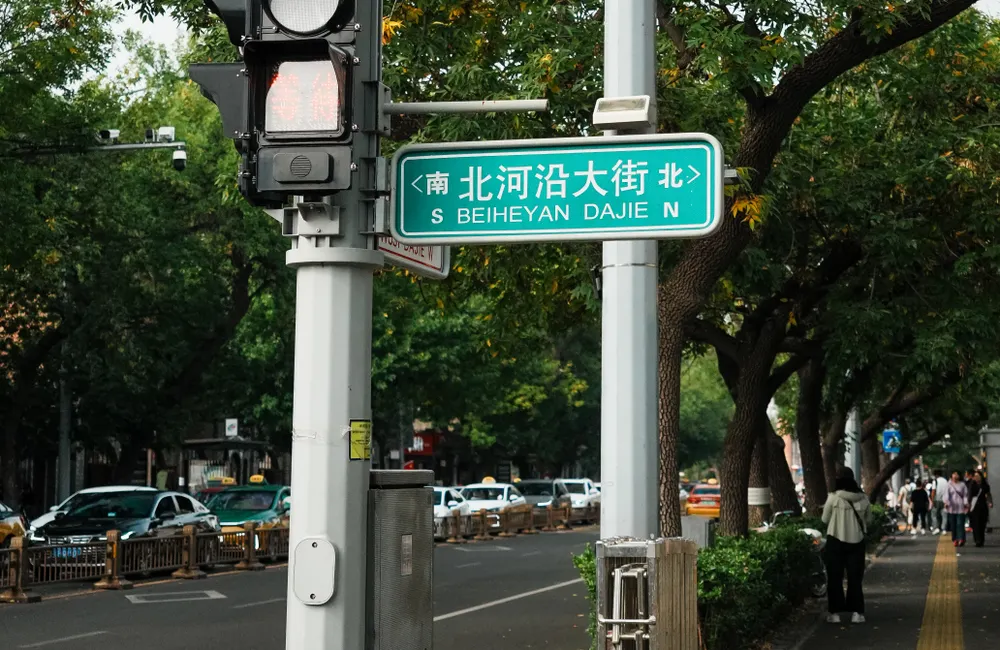
The bilingual street signage visible across Beijing is a useful reminder that wayfinding support exists in some form even where clinical language support does not. For how that support is actually obtained, see How to Use a Chinese Hospital as a Foreign Visitor.
Side-by-Side Comparison: City by Hospital Type, Report, Lead Time and Trip
The table below summarises the practical differences. Every row is a general pattern rather than a promise about a specific hospital: capacity, pricing and report practice vary between individual institutions within each city, and only the hospital itself can confirm what it will do for your specific request.
| Factor | Shanghai | Guangzhou | Beijing |
|---|---|---|---|
| International patient department depth | Highest density of JCI-accredited private hospitals | Large international departments, mid-to-high density | Deep academic tertiary base |
| Typical booking lead time | 2 to 6 weeks; longer in peak season | Often 1 to 4 weeks | 4 to 8 weeks for leading academic hospitals |
| English report option | Full translation and bilingual PDF commonly available | Available; depth varies by hospital — confirm in writing | Available via international department |
| DICOM imaging export | Commonly available | Available; confirm media type | Available; confirm processing time |
| International flight routing | Excellent global connectivity | Strong Southeast Asia and Hong Kong routing | Strong global connectivity |
| Direct billing with insurers | Available at larger private hospitals | Selective; confirm before travel | Available at major private and international departments |
| Add-on test depth | Broad, fast in-city substitution | Good core panels; advanced add-ons vary | Deepest specialist add-on bench |
| Trip cost profile | Highest daily cost | Moderate daily cost | Moderate to high daily cost |
Costs quoted by any city are screening costs, not diagnostic costs, and not treatment costs. For the items that frequently sit outside the quoted package, see China Health Check-up Hidden Costs. For what you should request in writing before you fly home, see What You Should Receive After a China Health Checkup.
How to Choose a City and What to Send QGO First
A workable choice is usually made by weighting one priority rather than by adding up scores. If the priority is English-language depth and report speed, Shanghai tends to dominate. If the priority is regional travel combined with a check-up, Guangzhou tends to fit. If the priority is deep specialist capacity, Beijing tends to fit. If the priority is a specific named hospital, that hospital decides the city.
Before sending anything to QGO, collect six items: your passport name exactly as printed, your travel date window, your prior reports and imaging, your current medication list, the questions your home physician wants answered, and your budget range for hospital fees separate from coordination. Missing prior records are the most common cause of a delayed itinerary, because repeat testing substitutes for history that was never sent.
What QGO coordinates is scheduling, hospital-side communication, document preparation, translation coordination and post-visit report handling. What QGO does not do is diagnose, treat, provide emergency care, interpret clinical results, replace your home physician’s judgement, or act as a guarantor of a hospital’s availability or of any outcome. QGO coordination fees are separate from hospital fees and are never bundled into a hospital quotation.
Frequently Asked Questions
Which city is best for a health check-up as a foreign visitor?
There is no single answer. Shanghai usually leads on international hospital density and English report speed, Guangzhou usually leads on booking availability and regional travel routing, and Beijing usually leads on specialist depth. The right choice depends on which of those matters most to you, or on a specific named hospital.
Is a China health check-up a diagnostic evaluation?
No. A health check-up is screening. It looks for signals that may justify further examination, but it does not diagnose. A licensed physician makes diagnostic decisions after examining you and reviewing your history. Whether your home-country physician accepts or acts on the report is their decision, not the hospital’s and not QGO’s.
Does the package price I am quoted cover everything?
A quoted package is an estimate of hospital-side test costs. Report translation, DICOM imaging export, courier delivery, add-on tests, specialist consultations and follow-up are frequently billed separately. Ask for an itemised written cost list before you confirm, and treat any estimate as an estimate rather than a final bill (估算不是最终账单, 最终收费以医院确认为准).
How far in advance should I book?
Two to six weeks is typical in Shanghai, four to eight weeks for leading academic hospitals in Beijing, and one to four weeks is often sufficient in Guangzhou. Peak travel periods lengthen every one of these. If you need a specific hospital, book before fixing your flights.
What does QGO coordinate for a health check-up visit?
QGO coordinates appointment scheduling, hospital-side communication, document preparation, translation coordination and post-visit report handling. QGO does not diagnose, treat, provide emergency care, interpret results, or promise hospital availability or outcomes.
How to Work With QGO on This Topic
If you want QGO coordination support, prepare your passport name, travel dates, prior reports, medication history, and the exact questions your home physician wants answered. QGO can organise non-emergency communication and appointment logistics. Clinical decisions, hospital acceptance and travel eligibility remain outside QGO control, and in any emergency dial 120 in China, 911 in the United States, or 999 in the United Kingdom.
References
Sources below are official government, accreditation body, and national hospital references for a YMYL medical-coordination topic. Last reviewed: 2026-10-26.
- National Health Commission of the PRC (国家卫生健康委员会)
- Joint Commission International (JCI accreditation standards)
- World Health Organization
- WHO International Travel and Health
- Peking Union Medical College Hospital (北京协和医院)
- Shanghai Huashan Hospital (上海华山医院)
- Peking University International Hospital (北京大学国际医院)
- West China Hospital, Sichuan University (华西医院)
- China Center for Disease Control and Prevention
- Chinese Hospital Association
- The State Council of the PRC (English portal)
- Ministry of Foreign Affairs of the PRC
- Image credit — stock photograph from Pexels (photo ID 16460876), used under the Pexels License. Licensed stock image from Pexels.
- Image credit — stock photograph from Pexels (photo ID 24349895), used under the Pexels License. Licensed stock image from Pexels.
- Image credit — stock photograph from Pexels (photo ID 30304302), used under the Pexels License. Licensed stock image from Pexels.
- Image credit — stock photograph from Pexels (photo ID 34449594), used under the Pexels License. Licensed stock image from Pexels.
Image credits